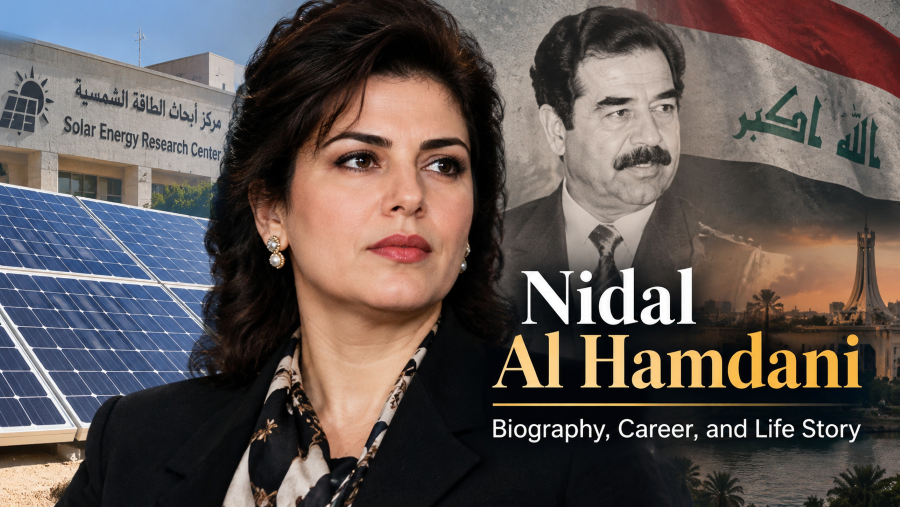
Nidal Al-Hamdani: Biography, Career, Personal Life, and What Is Known Today
Nidal Al-Hamdani is a name linked to both science and modern Iraqi history. She is mainly described as an Iraqi scientist and research administrator. Her professional work is often connected with solar energy research in Iraq. Her name later became widely known because of reported links to Saddam Hussein. However, many details about her private life remain unclear. Public records do not provide a complete biography of her childhood, education, or later years. Some websites also repeat details that cannot be independently confirmed. Therefore, her story needs a careful and balanced approach. Historical references describe her as the general manager of Iraq’s Solar Energy Research Center. Other sources describe her as Saddam Hussein’s alleged third wife. These claims appear in reference material, but the available evidence is not equally strong for every detail.
The most interesting part of her story is the contrast between her professional identity and her personal association with Iraq’s former leader. Before public attention focused on her private life, she was connected with scientific research. Her reported work involved solar energy during a period when Iraq was developing technical research institutions. Her name later appeared in accounts of Saddam Hussein’s family life. This combination made her a subject of historical curiosity. Yet there is still no complete public record covering every stage of her life. This article focuses on what can reasonably be established. It also explains which details remain uncertain. That distinction is important for anyone researching Nidal Al-Hamdani online.
Who Was Nidal Al-Hamdani?
Nidal Al-Hamdani is generally described as an Iraqi scientist and scientific administrator. Her name is most strongly associated with solar-energy research. Historical references identify her as the general manager of the Solar Energy Research Center within Iraq’s Council of Scientific Research.
Her professional background makes her different from many people who appear in stories about Saddam Hussein. Much of the public interest around her focuses on her reported marriage. Yet her scientific career deserves attention on its own. She was reportedly involved in a research field that explored the use of solar power. Solar energy was an important research subject for countries seeking alternatives and new technologies. Iraq had significant scientific institutions during the later twentieth century. These institutions supported research in several technical fields.
Still, a full academic biography of Nidal Al-Hamdani is difficult to find. Her exact university, degrees, research papers, and early career milestones are not clearly documented in accessible sources. For that reason, claims about specific qualifications should be treated carefully. Her known public profile is better described through her reported institutional role.
Nidal Al-Hamdani Biography Table
The following table separates commonly reported information from details that remain unknown.
| Biography Detail | Available Information |
| Full Name | Nidal Al-Hamdani |
| Nationality | Iraqi |
| Profession | Scientist and scientific administrator |
| Main Field | Solar-energy research |
| Reported Position | General Manager of the Solar Energy Research Center |
| Institution | Council of Scientific Research, Iraq |
| Birth Date | Not reliably confirmed |
| Birthplace | Not reliably confirmed |
| Education | Detailed records are not publicly verified |
| Reported Spouse | Saddam Hussein |
| Reported Marriage | Around 1990 |
| Children with Saddam Hussein | No children are reported from the marriage |
| Later Life | Very limited reliable public information |
| Current Status | Not clearly established in reliable public records |
Some reference sources specifically identify Nidal Al-Hamdani as the general manager of the Solar Energy Research Center. They also describe her as Saddam Hussein’s alleged third wife. Other details found online, including exact age, academic degrees, personal wealth, and later residence, are not supported by equally strong evidence. A responsible biography should not turn estimates into confirmed facts.
Her Early Life and Family Background
Very little reliable information exists about Nidal Al-Hamdani’s childhood. Publicly available biographies do not provide a firmly documented birth date. They also do not offer a detailed account of her parents, siblings, or childhood home. Some online articles suggest locations and family details, but these claims are not consistently supported by strong historical sources.
This lack of information is important when researching lesser-known historical figures. Internet biographies can quickly repeat the same statement across many websites. Repetition does not always mean independent confirmation. A claim may begin on one website and later appear on several others.
For Nidal Al-Hamdani, the safest approach is to focus on information connected to her documented professional identity. Her reported scientific position gives us a clearer view of her public role. Her early family life remains largely outside the available record. Until stronger historical evidence appears, exact details about her birth and upbringing should remain described as unknown.
Education and Scientific Interests
Nidal Al-Hamdani is often described online as a highly educated scientist. However, publicly accessible sources do not provide enough reliable evidence to confirm every claim about her academic education. In particular, her exact university, degree titles, and graduation dates are difficult to establish from dependable records.
What is more consistent is her association with solar-energy research. Her reported position at the Solar Energy Research Center suggests involvement with an important area of technical research. Solar power has long attracted attention in countries with large amounts of sunlight. Research in this area can involve energy conversion, thermal systems, equipment testing, and practical applications.
It is tempting to add impressive academic details to a biography. However, doing so without strong evidence can make an article less trustworthy. A people-first biography should clearly separate known facts from uncertain claims. In the case of Nidal Al-Hamdani, her reported leadership role is more useful than unsupported claims about specific degrees or scientific awards.
Nidal Al-Hamdani and Solar Energy Research
The professional story of Nidal Al-Hamdani is closely connected with solar energy. Reference material identifies her as the general manager of the Solar Energy Research Center under Iraq’s Council of Scientific Research.
This role is significant because research leadership involves more than technical knowledge. A senior research manager can be involved in planning, administration, staff coordination, and scientific projects. However, the surviving public information does not provide enough detail to describe her exact daily responsibilities.
Her reported position also places her within Iraq’s wider scientific development during the late twentieth century. The country invested in research and technical education during several periods. Energy research naturally had strategic importance in an oil-producing country.
Her story therefore has value beyond her connection with Saddam Hussein. It provides a glimpse into the role of scientific professionals during a complicated period in Iraqi history. At the same time, there is not enough reliable information to measure her individual scientific achievements in detail. Readers should avoid accepting claims about specific inventions, discoveries, or research projects unless they can be supported by credible records.
Why Her Scientific Career Matters
Nidal Al-Hamdani’s reported career matters because it shows that her public identity did not begin with politics. Her professional association with solar energy existed separately from the later attention surrounding her personal life.
Women working in science and technical administration can be overlooked when historical stories focus mainly on political leaders. Her reported leadership position suggests that she held an important place within Iraq’s research system. Yet the limited documentation makes it difficult to reconstruct her career year by year.
This is one reason a balanced biography is useful. It is easy to describe someone only through their famous relationship. That approach can leave out the person’s earlier professional identity. In Nidal Al-Hamdani’s case, the scientific side of her story deserves consideration.
At the same time, readers should not exaggerate her achievements without evidence. Claims about major scientific breakthroughs, large research teams, or international awards require supporting documentation. The strongest available descriptions identify her with solar-energy research and scientific administration.
Was Nidal Al-Hamdani Married to Saddam Hussein?
Nidal Al-Hamdani is widely described in reference material as Saddam Hussein’s alleged third wife. A historical reference identifies her as the general manager of the Solar Energy Research Center and says she was allegedly married to Hussein. CNN’s current biographical reference for Saddam Hussein also lists Nidal Al-Hamdani among his marriages, giving the period as 1990 until his death in 2006.
However, online accounts differ in how they describe the relationship. Some sources present the marriage as established fact. Others use terms such as “alleged” or “reported.” This difference is worth noting because documentation about private relationships within Saddam Hussein’s inner circle can be difficult to verify.
The reported marriage is one reason her name remains connected with Iraqi political history. It also changed public interest in her from scientific research to personal life. Still, the available information does not provide a complete account of the relationship. Details about how they met, their private life, and their daily circumstances should therefore be treated carefully.
When Was the Reported Marriage?
Several reference sources place the reported marriage around 1990. CNN’s biographical material lists Nidal Al-Hamdani as a spouse beginning in 1990. Other historical references also associate the marriage with that period.
The exact circumstances surrounding the marriage are less clear. Many online biographies include detailed stories about how the relationship began. Some also make claims about her previous marriage and the circumstances surrounding it. However, these details are not supported equally by reliable primary documentation.
For this reason, it is better to keep the timeline simple. The commonly reported account places the marriage around 1990. Saddam Hussein died on December 30, 2006, and several biographical references list the marriage as lasting until his death.
This basic timeline is more dependable than adding dramatic details that cannot be verified. Good historical writing should give readers enough context without presenting uncertain stories as established facts.
Did Nidal Al-Hamdani Have Children?
Available reference material does not report children from the marriage between Nidal Al-Hamdani and Saddam Hussein. An older reference specifically states that she had no sons or daughters from the marriage.
Saddam Hussein had children from other relationships. His first wife, Sajida Talfah, was the mother of several children. His reported second wife, Samira Shahbandar, was the mother of Ali Saddam Hussein.
This distinction is useful because online biographies sometimes combine information about different members of Saddam Hussein’s family. A reader may therefore encounter incorrect claims about Nidal Al-Hamdani having children.
There is no strong public evidence showing that she had children with Saddam Hussein. Details about any children from an earlier relationship are also not clearly established in reliable public sources. Therefore, a careful biography should not invent family information simply to fill gaps.
Nidal Al-Hamdani After the 2003 Iraq War
One of the biggest unanswered questions concerns Nidal Al-Hamdani’s life after the 2003 invasion of Iraq. Public information about her later years is extremely limited. Sources discussing her biography generally acknowledge that her whereabouts became unclear after the fall of Saddam Hussein’s government.
Unlike Saddam Hussein, whose capture, trial, and execution received extensive international coverage, Nidal Al-Hamdani largely disappeared from public reporting. There is no widely accepted public biography that provides a complete post-2003 timeline.
This absence has encouraged speculation. Some websites claim to know where she lived or what happened to her. However, such claims should not automatically be accepted. Without reliable documentation, it is safer to say that her later whereabouts are not publicly established.
Her disappearance from public attention is perhaps the most mysterious part of her biography. It also explains why searches for her name often produce conflicting answers. Readers should distinguish between documented history and internet speculation.
Where Is Nidal Al-Hamdani Today?
The current whereabouts of Nidal Al-Hamdani are not clearly established by reliable public sources. Recent biographies acknowledge the lack of confirmed information about her post-2003 life.
Some websites describe her as missing, while others make unsupported claims about her location or present status. There is not enough dependable evidence to confirm these statements. It would therefore be misleading to state a specific location as fact.
The same issue applies to claims about whether she is alive today. No strong public evidence located for this article provides a definitive answer. A responsible article should not convert the absence of information into a claim of death or survival.
This uncertainty is part of the reason Nidal Al-Hamdani continues to attract searches. Her name remains connected to a major historical period, yet her own later story is poorly documented. Future archival research may provide additional information. Until then, her current status should be described as unknown rather than guessed.
What Makes Her Story Interesting?
Nidal Al-Hamdani’s story is interesting because it combines two very different areas of history. One side involves science and solar-energy research. The other involves Iraq’s political leadership under Saddam Hussein.
Her reported professional position gives her an identity beyond her personal relationships. She was associated with scientific administration during a period of major change in Iraq. Later, her reported marriage placed her name within the country’s political history.
That combination explains why people continue searching for her biography. Yet her story also shows the problems of researching private historical figures. When documentation is limited, gaps are often filled with assumptions. Online articles can then repeat those assumptions until they appear to be established facts.
A better approach is to keep the known information separate from uncertain details. Her reported scientific role, nationality, and association with Saddam Hussein can be discussed with appropriate sourcing. Her exact age, education, wealth, and current location require more caution.
Nidal Al-Hamdani’s Public Legacy
The public legacy of Nidal Al-Hamdani is difficult to define because her life has not been documented in the same way as major political figures. Her reported work in solar energy remains an important part of her public identity. Her association with Saddam Hussein is the other major reason her name appears in historical discussions.
It is worth remembering that these two parts of her story are not the same. A professional career should not automatically be judged through a later personal association. Likewise, a personal connection to a political leader does not provide enough evidence to describe every part of someone’s career.
The limited record also means that strong claims about her achievements should be avoided. There are not enough publicly available research records to create a complete list of her scientific contributions.
For modern readers, perhaps the clearest lesson is the value of careful historical research. Nidal Al-Hamdani’s biography contains known facts, reported claims, and major unanswered questions. Keeping those categories separate produces a more useful and trustworthy account.
Common Myths About Nidal Al-Hamdani
Many internet pages present exact details about Nidal Al-Hamdani’s age, education, wealth, and family. Some even provide precise estimates without showing reliable evidence. These details should be approached carefully.
One common mistake is treating an estimated birth year as confirmed. Another is presenting a specific university or academic degree as fact when reliable sources do not clearly document it. Similar problems occur with claims about her current location.
Another issue is the use of fictionalized interviews. Some websites publish conversations written as if Nidal Al-Hamdani personally answered questions. Unless an original interview can be verified, such material should not be treated as a genuine historical source.
A trustworthy biography should avoid invented quotations and unsupported personal details. It should also make clear when information comes from secondary sources. This approach gives readers a more accurate understanding of what is actually known about Nidal Al-Hamdani.
Why Reliable Sources Matter When Researching Her
Researching a lesser-known historical figure requires extra care. A search engine can return dozens of pages that appear to confirm the same detail. Yet those pages may all be repeating information from one original claim.
Nidal Al-Hamdani is a good example of this problem. Her basic professional identity appears in several reference sources. Her reported connection with Saddam Hussein also appears in established biographical material.
Other details are much less certain. Exact birth information, academic history, personal wealth, and later whereabouts often vary between websites. These differences are a warning sign for researchers.
The best approach is to compare sources and identify information that remains consistent. When evidence is weak, it is better to say “not confirmed” than to provide an attractive but unsupported answer. That method creates a biography that readers can trust.
Frequently Asked Questions
1. Who was Nidal Al-Hamdani?
Nidal Al-Hamdani was an Iraqi scientist and scientific administrator associated with solar-energy research. Historical references identify her as the general manager of Iraq’s Solar Energy Research Center. She later became known because of her reported marriage to Saddam Hussein.
2. What was Nidal Al-Hamdani’s profession?
She is commonly described as a scientist and research administrator. Her reported professional role involved the Solar Energy Research Center under Iraq’s Council of Scientific Research. Detailed information about her individual research projects is limited.
3. Was Nidal Al-Hamdani Saddam Hussein’s wife?
Historical and biographical sources report that Nidal Al-Hamdani was Saddam Hussein’s third wife. CNN’s biographical reference lists the marriage beginning in 1990. Some historical references use the word “alleged,” showing that details about the relationship are not equally documented.
4. Did Nidal Al-Hamdani have children with Saddam Hussein?
Available reference material does not report children from their marriage. An older biographical reference specifically states that she had no sons or daughters with Saddam Hussein.
5. What happened to Nidal Al-Hamdani after 2003?
Her later life is not well documented. Public biographies provide little reliable information about her movements after the 2003 invasion. Her exact whereabouts have not been firmly established in the sources reviewed for this article.
6. Is Nidal Al-Hamdani alive today?
Her present status is not clearly confirmed by reliable public information. Some websites make claims about her current situation, but the available evidence does not establish a definitive answer. It is therefore more accurate to describe her current status as unknown.
Conclusion
Nidal Al-Hamdani remains a fascinating but poorly documented figure in modern Iraqi history. Her name is connected with solar-energy research, scientific administration, and the reported marriage to Saddam Hussein. Her professional identity is especially important because it is often overshadowed by her personal connection to Iraq’s former leader.
The available evidence gives us some useful facts. She was Iraqi, worked in scientific administration, and was associated with the Solar Energy Research Center. Historical sources also report her marriage to Saddam Hussein around 1990. Beyond these points, many parts of her story remain uncertain.
That uncertainty should not be filled with guesses. Her age, education, wealth, private family history, and present location require stronger evidence. For readers researching Nidal Al-Hamdani, the best approach is to compare sources and separate documented information from repeated online claims. Her story reminds us that a person’s biography can contain important unanswered questions. As new historical records become available, those gaps may eventually be filled.

Ryan Beck is an experienced SEO strategist and blogging expert with over 20+ years of hands-on experience in digital marketing. He has built a strong reputation for helping businesses grow their online presence through data-driven SEO strategies, high-quality content creation, and audience-focused blogging.