OpenAI Ownership: Who Owns OpenAI and How Its Structure Works
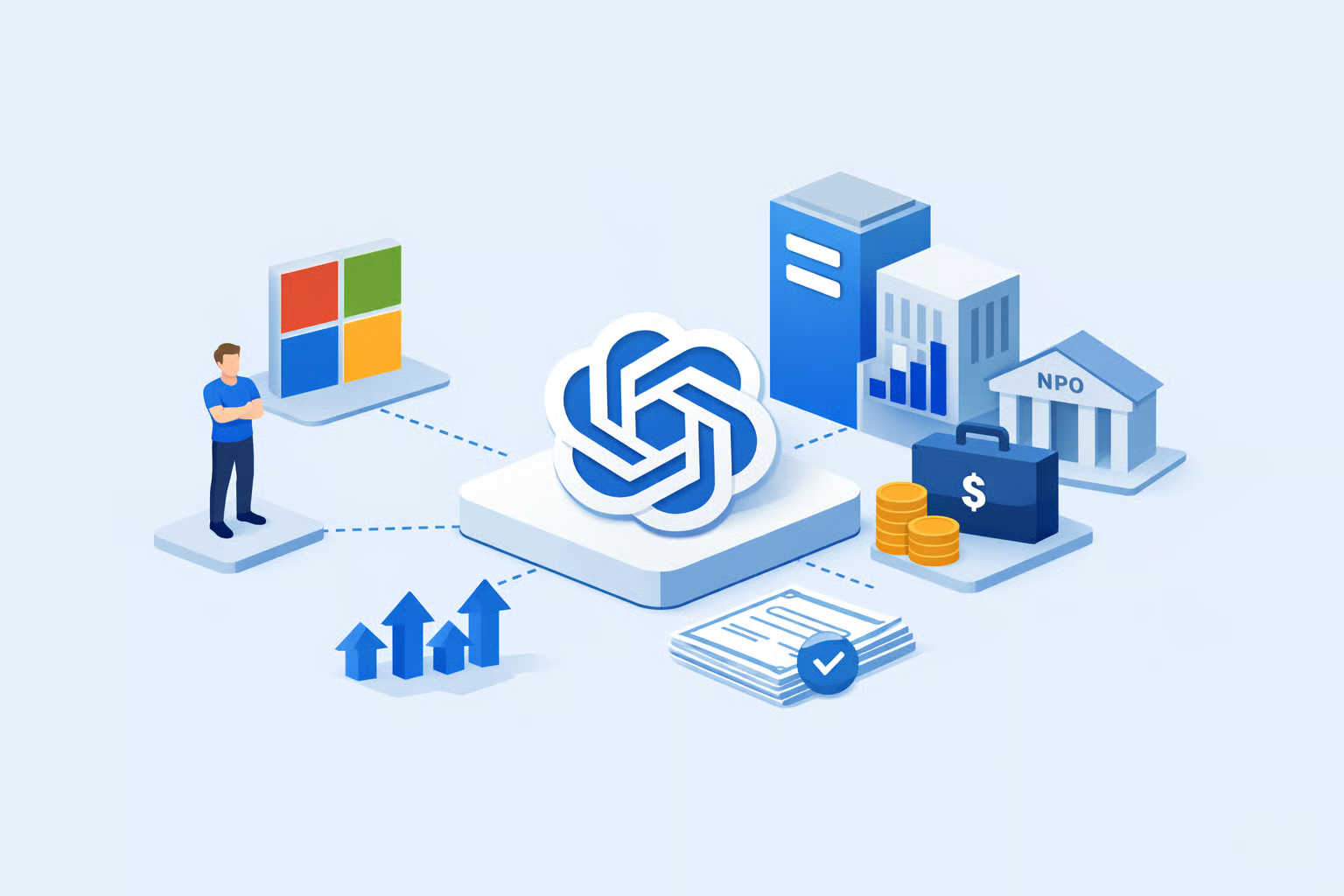
OpenAI ownership can seem confusing because OpenAI is not owned by one person. Its structure combines a nonprofit foundation with a public benefit corporation. OpenAI began in 2015 as a nonprofit research organization. Later, it created a for-profit entity to raise the huge amount of money needed for advanced AI research. In October 2025, OpenAI completed a major recapitalization. The nonprofit became the OpenAI Foundation, while the business became OpenAI Group PBC. The Foundation continues to control the for-profit company.
This structure makes OpenAI different from a typical technology company. Microsoft is a major investor, but it does not own the whole company. Other investors and employees also hold economic interests. The Foundation has an important governance role. This article explains the structure in simple language. It also covers Sam Altman, Microsoft, investors, voting control, company history, and what ownership means today.
What Does OpenAI Ownership Mean?
The term OpenAI ownership refers to both economic ownership and control. These are not always the same thing. A person or company can hold shares without controlling every major decision. OpenAI uses a structure where the nonprofit Foundation controls the for-profit business. The business is called OpenAI Group PBC. PBC means Public Benefit Corporation. It is designed to balance business goals with a stated public benefit purpose.
OpenAI’s current structure was completed in October 2025. The Foundation holds equity in OpenAI Group. OpenAI says that equity was valued at about $130 billion at the time. Microsoft separately holds a significant investment in OpenAI Group. Employees and other investors also have economic interests. Therefore, saying that one individual simply owns OpenAI would give an incomplete picture. The company has several economic stakeholders and a nonprofit controlling organization.
Who Owns OpenAI Today?
The simplest answer to OpenAI ownership is that the OpenAI Foundation controls OpenAI Group PBC. OpenAI states that the Foundation remains in control of the for-profit company. It also holds a substantial equity position. This gives the nonprofit both governance authority and a financial interest in the company’s growth.
Microsoft is another major stakeholder. Under the October 2025 agreement, Microsoft held an investment valued at approximately $135 billion. OpenAI described that position as roughly 27% on an as-converted diluted basis. This percentage includes all owners in the calculation.
Other ownership interests belong to employees and investors. Their exact percentages can change after funding rounds and other corporate transactions. That is why ownership figures should always be connected to a specific date.
OpenAI Ownership Structure Explained
The OpenAI ownership structure has two major parts. The first is the OpenAI Foundation. It is the nonprofit organization that controls the business. The second is OpenAI Group PBC, which operates the commercial side of the organization. The two entities share the same broad mission.
This setup replaced OpenAI’s earlier capped-profit structure. The earlier model was created in 2019. It allowed investors and employees to receive financial returns within agreed limits. The nonprofit retained control under that arrangement. OpenAI later decided that a conventional equity structure would make it easier to raise large amounts of capital.
The newer PBC model gives investors ordinary economic interests. At the same time, the Foundation keeps control over the organization. This creates a separation between financial participation and ultimate governance.
OpenAI Ownership and the OpenAI Foundation
The OpenAI Foundation is central to OpenAI ownership today. OpenAI says the Foundation controls OpenAI Group PBC. The Foundation also owns equity in the company. Its financial interest can grow as the commercial company becomes more valuable.
The Foundation has a nonprofit mission. OpenAI says its purpose includes helping ensure that artificial general intelligence benefits humanity. Its work can extend beyond the company’s commercial products. In March 2026, OpenAI said the Foundation was beginning to use its resources for health and AI resilience initiatives.
This arrangement is important because the nonprofit is not simply a historical name. It has a continuing governance role. It also has a direct financial connection to OpenAI Group. That makes the current structure different from a normal company controlled only by private shareholders.
Is Microsoft the Owner of OpenAI?
Microsoft is a major investor, but OpenAI ownership is not the same as Microsoft ownership. Microsoft does not own all of OpenAI. Under the October 2025 agreement, Microsoft held about 27% of OpenAI Group on an as-converted diluted basis. OpenAI also stated that the investment was valued at approximately $135 billion.
The relationship between the companies is broader than an ordinary investment. Microsoft and OpenAI have worked together since 2019. Their partnership has included investment, cloud computing, and technology collaboration. The 2025 agreement changed parts of that relationship while keeping a major commercial partnership in place.
Therefore, a simple statement such as “Microsoft owns OpenAI” misses the current structure. Microsoft is an important shareholder and strategic partner. The OpenAI Foundation remains the controlling organization.
Does Sam Altman Own OpenAI?
Sam Altman is strongly associated with OpenAI, but OpenAI ownership should not be confused with executive leadership. Altman has served as OpenAI’s CEO. Being CEO does not mean that he personally owns the company or controls the Foundation.
OpenAI’s corporate structure separates leadership from ownership and governance. The Foundation controls OpenAI Group, while shareholders have economic interests. Employees can also hold interests in the commercial company. This means the CEO’s role is different from the role of the controlling nonprofit.
This distinction is useful when reading online discussions about OpenAI. A company’s founder or CEO can be highly influential without personally owning the majority of its equity. OpenAI’s structure makes that distinction especially important because it combines nonprofit control with commercial ownership.
OpenAI Ownership: Complete Company Details Table
Here is a simple reference table for understanding the current structure.
| Detail | Information |
| Company | OpenAI |
| Current for-profit entity | OpenAI Group PBC |
| Controlling nonprofit | OpenAI Foundation |
| Original organization | OpenAI nonprofit |
| Founded | 2015 |
| For-profit structure created | 2019 |
| Current PBC structure | Completed in 2025 |
| Major strategic investor | Microsoft |
| Microsoft’s stated stake | About 27% |
| Foundation equity value stated by OpenAI | About $130 billion |
| CEO | Sam Altman |
| Business type | Public Benefit Corporation |
| Main focus | Artificial intelligence |
| Mission | Ensure AGI benefits all humanity |
| Major products | ChatGPT and AI models |
| Ownership model | Foundation control plus shareholder interests |
The figures above are tied to OpenAI’s published 2025 structure. Ownership percentages can change after future financing or corporate transactions.
How OpenAI Changed From 2015 to 2025
Understanding the history makes OpenAI ownership easier to understand. OpenAI started in 2015 as a nonprofit. The organization wanted to develop advanced AI while focusing on broad human benefit. As AI research became more expensive, OpenAI needed much more computing power and investment capital.
In 2019, OpenAI created a for-profit subsidiary. This helped the organization raise money and expand its research. The for-profit entity was controlled by the nonprofit. Its original structure used a capped-profit model for investors and employees.
OpenAI later concluded that a more conventional capital structure would help it raise the resources needed for large-scale AI development. In 2025, it moved the commercial business into a Public Benefit Corporation. The nonprofit retained control while receiving a major equity interest.
Why Does OpenAI Use a Public Benefit Corporation?
A Public Benefit Corporation is a for-profit company with a stated public benefit purpose. It still operates commercially, but its structure considers more than ordinary shareholder returns. OpenAI selected this model as part of its 2025 restructuring.
This matters when discussing OpenAI ownership because a PBC is different from a traditional corporation. OpenAI Group can raise capital and issue ordinary shares. At the same time, its stated mission remains part of the company’s purpose. The Foundation controls the company and has its own nonprofit mission.
The model attempts to combine two needs. OpenAI needs enormous capital for computing, research, infrastructure, and talent. It also wants its nonprofit mission to remain important. The PBC structure provides a commercial framework while keeping the Foundation in control.
Who Are the Main OpenAI Stakeholders?
The main groups connected to OpenAI ownership include the OpenAI Foundation, Microsoft, employees, and other investors. Each group can have different interests. The Foundation has the special role of controlling the for-profit organization. Investors have economic interests tied to the company’s value. Employees can also receive equity or other forms of financial participation.
Microsoft has one of the largest disclosed outside positions. OpenAI reported Microsoft’s investment at approximately 27% on an as-converted diluted basis after the 2025 recapitalization.
The exact ownership picture can become more complicated after new funding. Private companies can issue additional shares or change their capitalization. For that reason, readers should avoid treating an old ownership chart as permanent. Current company disclosures provide the most useful reference point.
Elon Musk and OpenAI Ownership History
Elon Musk was involved with OpenAI during its early period. He left the organization’s board in 2018. He is not the current owner of OpenAI. OpenAI has publicly described disagreements from that period concerning the company’s future structure and control.
This history sometimes creates confusion about OpenAI ownership. Early involvement does not mean current ownership. Musk’s departure occurred years before the current Foundation and PBC structure. Today’s OpenAI Group is organized under the OpenAI Foundation’s control.
It is also important to separate documented history from competing claims. OpenAI and Musk have publicly disagreed over aspects of the organization’s history and restructuring. Those claims should be read with their sources and dates in mind. The current ownership structure is separate from those earlier disputes.
Why OpenAI Ownership Matters
Understanding OpenAI ownership helps explain how the company balances investment and mission. Advanced AI development requires large amounts of computing infrastructure, research talent, energy, and capital. A commercial company can raise significant funds for those needs. The Foundation provides a separate governance layer.
The structure also helps explain why Microsoft can have a large investment without controlling OpenAI. It shows that financial ownership and organizational control can be different. The Foundation’s position gives it authority over the commercial organization, while shareholders receive economic interests.
For readers, this distinction is useful when evaluating news reports about OpenAI. Headlines may use words like “investor,” “owner,” “partner,” or “controller.” These words do not always mean the same thing. Looking at the actual corporate structure provides a clearer picture.
What Could Change in OpenAI Ownership?
Future changes are possible. Private companies can raise additional capital, issue shares, and change their capitalization. New investments can affect the percentage held by existing shareholders. This means today’s percentage figures should not automatically be treated as permanent.
However, OpenAI has stated that the OpenAI Foundation controls OpenAI Group. The Foundation also holds a major equity position.
The most important point is that OpenAI ownership has both financial and governance dimensions. Future financing could change economic percentages. Corporate governance could also evolve. Readers should therefore check recent company announcements when they need exact figures.
Frequently Asked Questions About OpenAI Ownership
1. Who owns OpenAI?
The OpenAI Foundation controls OpenAI Group PBC. The commercial company also has shareholders, including Microsoft, employees, and other investors. OpenAI says the Foundation remains in control of the for-profit business.
2. Does Microsoft own OpenAI?
Microsoft does not own all of OpenAI. It holds a major investment in OpenAI Group. OpenAI reported Microsoft’s position at about 27% on an as-converted diluted basis after the 2025 recapitalization.
3. Does Sam Altman own OpenAI?
Sam Altman is OpenAI’s CEO, but being CEO is different from owning the company. The OpenAI Foundation controls the commercial organization. Ownership also includes other shareholders and investors.
4. What is OpenAI Group PBC?
OpenAI Group PBC is the commercial company created through OpenAI’s 2025 restructuring. PBC means Public Benefit Corporation. It operates as a for-profit business while sharing OpenAI’s broader mission.
5. Who controls the OpenAI Foundation?
The Foundation is the nonprofit organization that governs and controls OpenAI Group. Its board provides the nonprofit’s governance. The Foundation also has a major financial interest in the commercial company.
6. Can OpenAI ownership change?
Yes. Ownership percentages can change through fundraising, new shares, or other corporate transactions. The Foundation’s control is the key feature of the current structure. Exact financial percentages should always be checked against the latest company disclosures.
Conclusion
OpenAI ownership is more complex than saying one person or company owns the business. OpenAI now operates through OpenAI Group PBC, while the OpenAI Foundation remains the controlling nonprofit. Microsoft is a major investor, with OpenAI reporting a roughly 27% stake after the 2025 restructuring. Employees and other investors also have economic interests.
The structure has changed significantly since OpenAI’s nonprofit beginning in 2015. The 2019 for-profit structure helped attract capital for expensive AI research. The 2025 recapitalization created a simpler commercial structure while keeping nonprofit control. This makes OpenAI ownership an interesting example of how technology companies can combine investment, governance, and public-benefit goals. For the latest figures, readers should always check recent OpenAI disclosures because private-company ownership can change over time.

Ryan Beck is an experienced SEO strategist and blogging expert with over 20+ years of hands-on experience in digital marketing. He has built a strong reputation for helping businesses grow their online presence through data-driven SEO strategies, high-quality content creation, and audience-focused blogging.